
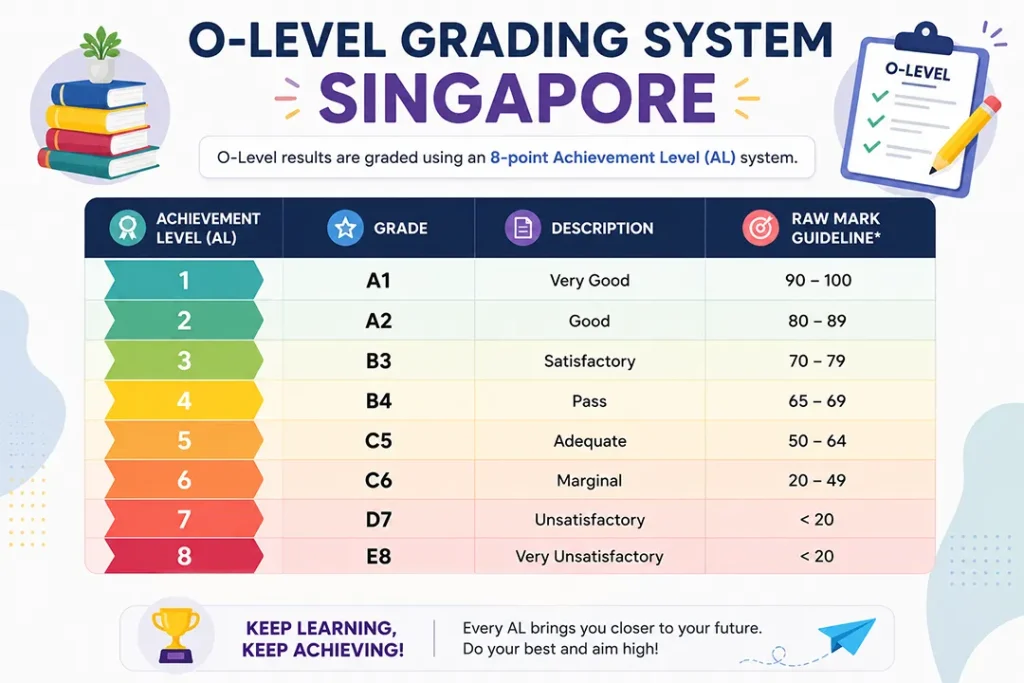
The O-Level grading system Singapore remains one of the most important academic frameworks for secondary school students planning their post-secondary education journey. For students aiming for Junior Colleges, Polytechnics, Millennia Institute, or other educational pathways, understanding how grades are calculated can significantly influence academic strategy and long-term opportunities.
Singapore’s O-Level examination system evaluates subject mastery through the Singapore-Cambridge GCE O-Level framework, administered jointly by the Singapore Examinations and Assessment Board (SEAB), the Ministry of Education (MOE), and Cambridge International. Results are used to determine eligibility for future educational pathways, making grade interpretation essential.
A clear understanding of What is the O Level grading system?, how points are calculated, and how aggregate scores work can help students set realistic goals, maximise subject performance, and make informed educational decisions.
The O-Level grading system Singapore uses grades from A1 to F9, with lower point totals representing stronger academic performance. Aggregate systems such as L1R5, L1R4, and ELR2B2 determine admission eligibility for Junior Colleges, Polytechnics, and other post-secondary institutions.
What Is the O Level Grading System?
Singapore’s O-Level grading structure assigns grades ranging from A1 to F9 for each subject. Each grade reflects a candidate’s academic performance based on national standards. The standard grade breakdown generally follows this structure:
A1 represents the highest distinction, followed by A2, B3, B4, C5, C6, D7, E8, and F9. Lower numerical scores indicate stronger academic performance, meaning A1 is the best possible grade while F9 is the lowest.
Passing grades are typically considered C6 and above for many progression pathways, though more competitive institutions often require stronger aggregate scores.
This grading model provides consistency across national examinations and supports standardised post-secondary admissions.
What Is the O Level Grading System in Singapore?
For those asking, What is the O level grading system in Singapore?, the system is not solely based on individual subject grades but also on aggregate scoring methods.
Each subject grade corresponds to a numerical point value:
| Grade | Marks (%) |
| A1 | 75 – 100 |
| A2 | 70 – 74 |
| A3 | 65 – 69 |
| A4 | 60 – 64 |
| A5 | 55 – 59 |
| A6 | 50 – 54 |
| A7 | 45 – 49 |
| A8 | 40 – 44 |
| A9 | 0 – 39 |
Students combine their best relevant subjects based on the educational pathway they plan to pursue, helping them meet admission requirements, improve overall scores, and align academic performance with future educational goals and career aspirations effectively.
This means stronger grades result in lower aggregate scores, improving admission competitiveness and increasing opportunities for students to qualify for preferred schools, courses, and educational pathways based on their overall academic performance and examination results.
How Does the O-Level Grading System Work in Singapore?
Understanding How Does the O-Level Grading System Work in Singapore? is essential for educational planning. The system assesses students through individual subject performance and aggregate point calculations for admissions.
For Junior College admissions, students typically use the L1R5 system, which includes one language subject (L1) and five relevant subjects (R5). For Millennia Institute, the L1R4 system applies.
For Polytechnic admissions, the ELR2B2 system is often used, focusing on English, two relevant subjects, and two best subjects. The lower the total score, the better the student’s academic standing for admissions.
Bonus points from co-curricular achievements or Higher Mother Tongue may further reduce aggregate scores in certain circumstances. This system rewards both academic excellence and holistic development.
How to Calculate O Level Points in Singapore
A major concern for students is understanding how to calculate O-Level points in Singapore, as aggregate scores play an important role in determining eligibility for junior colleges, polytechnics, and other educational pathways after examination results are released.
The process involves converting each subject grade into numerical points and adding together the required subject categories.
For example, if a student scores:
| Subject | Point |
| English | A2 (2 points) |
| Mathematics | A1 (1 point) |
| Science | A2 (2 points) |
| Humanities | B3 (3 points) |
| Additional Math | B3 (3 points) |
| Mother Tongue | B4 (4 points) |
Their L1R5 aggregate would be 15 points. If eligible bonus points apply, these are deducted from the raw score. For example, a raw score of 15 with 2 bonus points becomes a net score of 13.
Students aiming for top-tier Junior Colleges often target significantly lower net scores, while Polytechnic pathways may have broader score flexibility.
How to Calculate Your O Level Points Effectively
Students frequently ask how to calculate their O-Level points, as understanding the scoring system helps them evaluate academic performance, determine eligibility for preferred courses or institutions, and make informed decisions about future educational pathways and career opportunities in Singapore.
The most effective strategy is to:
First, identify the admission pathway, whether JC, MI, or Polytechnic. Second, convert individual grades into point values.
Third, select the best qualifying subjects under the chosen admission formula. Fourth, calculate total raw points. Finally, apply any bonus deductions where eligible.
This strategic calculation helps students prioritise subject performance and understand which subjects most strongly influence future admissions.
Singapore Grading System and Academic Competitiveness
The broader Singapore grading system is internationally recognised for its rigour and meritocratic structure.
O-Level results are highly competitive because they directly shape future educational opportunities. Strong academic performance can open pathways to elite Junior Colleges, specialised Polytechnics, and scholarship opportunities.
Because Singapore’s system emphasises mastery rather than relative ranking, students are graded against established standards rather than fixed quotas. National exams are standards-referenced rather than bell-curved.
This structure encourages students to focus on individual mastery while maintaining high national educational standards.
Common Mistakes Students Make When Understanding O-Level Scores
Many students misunderstand how aggregate scoring works. Some focus too heavily on individual grades without considering total point strategy. Others overlook bonus point opportunities or misunderstand subject grouping rules.
A common misconception is that only overall passes matter, when in reality, aggregate competitiveness often determines educational opportunities.
Students should carefully evaluate both raw and net scores when planning applications. Accurate score calculation often improves decision-making, subject prioritisation, and post-secondary outcomes.
Why Understanding the O-Level Grading System Matters
Understanding the O-Level grading system Singapore offers strategic advantages. Students can set realistic score goals, improve subject prioritisation, reduce admissions uncertainty, and better plan academic pathways.
Parents also benefit from understanding how scores influence school options, allowing more informed educational guidance.
This knowledge is especially important in Singapore’s highly competitive academic environment.
Conclusion
The O-Level grading system Singapore is a critical framework that shapes educational progression for thousands of students each year. By understanding What is the O Level grading system, How to calculate O level points in Singapore, and How Does the O-Level Grading System Work in Singapore, students and parents gain valuable clarity for strategic academic planning.
Mastering the grading system allows students to optimise subject combinations, target competitive scores, and make informed decisions about future educational pathways.
In Singapore’s academically demanding environment, understanding the grading system is not simply helpful, it is essential for maximising opportunity and long-term success.
Frequently Asked Questions
What is the O Level grading system?
Singapore’s O-Level grading system uses grades from A1 (best) to F9 (lowest), with each grade assigned a point value.
What is the O level grading system in Singapore?
It combines individual subject grades into aggregate scores for admissions pathways such as JC, Polytechnic, or Millennia Institute.
How to calculate O level points in Singapore?
Convert grades into numerical values and add the relevant subjects according to the required admission formula.
What is the grading system in O Levels?
Students are graded using A1 to F9, with lower scores indicating stronger performance.
How does the O-Level grading system work in Singapore?
It combines subject grades, aggregate formulas, and possible bonus points to determine post-secondary admissions competitiveness.